Between work, coughing (hubby is sick too) and being glued to reports of the dire events in Japan, Libya and elsewhere, I haven't been posting. I'm finally having a whole weekend off, and hope to get some urgent projects started at least.
I finally got one of the jar sealers for the Foodsaver that I order so I can start vacuum sealing my jars of dry goods (vegetable flakes, soup makings of various kinds, etc), and I have a couple of kilograms of blueberries cleaned and ready to go in the freezer that needs to be made into jam, and some herbs to get started in the window for hubby. As he keeps tell me, a great chef like himself needs his own herb garden in the kitchen windowsill. I believe it was wisdom on my part not to giggle at him. I figure if he keeps practicing his culinary skills, he'll get better. I hope.
My heart goes out to the folks in Japan. For those most directly affected, the events of the last few weeks (has it really been that long?) will be with them for the rest of their lives and they are living through the kind of thing that a lot of us prepping for and hope will never happen. I have family living outside of Tokyo, and it's a real worry to me. As you can imagine, it's difficult to sleep sometimes. Are they really okay? Knowing that they were not directly harmed by the earthquake and that the tsunami didn't reach their neighbourhood is reassuring only to a point. Reading that the tap water in Tokyo is contaminated, and unsafe for children, is truly frightening.
We haven't heard a whole lot about Haiti recently beyond the news that a devasting cholera epidemic has set in. Innocent civilians are being killed as war heats up in Libya. People are still trying to rebuild after the earthquakes in Chile and New Zealand, and the floods in Australia. Truly, we have entered an age of catastrophe.
Living on the Pacific ring of fire as I do, earthquakes, volcanic activity and resultant tsunamis are actually some of the things I have to prep for. So among my weekend projects is going to have to be revamping the BOBs and the EDC.
Showing posts with label foodstoragemadeeasy. Show all posts
Showing posts with label foodstoragemadeeasy. Show all posts
Friday, March 25, 2011


Monday, February 7, 2011
Age and the Prepper
Earlier in the month, I was reading a blog entry from down---to---earth's Rhonda Jean about aging (Ageing and death - the final taboo), touching on the modern refusal to be old, as if it were some bad thing. I found it very interesting and thought-provoking, particularly looking at it from a prepper point of view.
I agree with Rhonda Jean in that I no longer feel a desire to look younger than I am. When I hit my fiftieth birthday, as a gift to myself, I gave myself permission to be my age without conforming to stereotypes about what my age should look like, or the new stereotype that if you don't look 20 years younger than you are, there's something wrong with you. This was actually a bit difficult for me as I come from a family of fashionistas.
After thinking more on the subject of age, I came to the realization that being the age I am (51) is absolutely great! I've got a bank of experience and knowledge that is useful in a wide variety of circumstances, and will be useful in a wide array of scenarios, and so does hubby (yeah, the grasshopper has skills). I've lived without the comforts of civilization (outhouse anyone?) at different points of my life, and have learned those little tricks that make uncomfortable situations less difficult. And I still have my health and a measure of strength.
One thing that Rhonda Jean said really sticks with me: "I like the way old people look." I think that a lot of people do. Young people in particular who don't have "old" grandparents like to be around people who are comfortable in their wrinkly skins, because they so often don't feel comfortable in their own hides. I am sincerely am glad that I'm not that young any more. I don't miss the drama at all!
So if you are older, and thinking that it's too late to start prepping, stop that negative energy right now! You are never too old to want to keep on living, and you are never too old to want to look after your family. So if you want to be prepared, get to it! Figure out what you are preparing for: retirement, unemployment, forest fires, tsunamis, earthquakes, zombie attacks. Make a plan. Follow it (very important!).
Check out City Roots, Country Life, specifically their excellent post on shopping around for the best prices here. These folks that took a long, hard, practical look at getting prepared, and not buying into the hype. Price tracking is an excellent way to get prepared, not just for food and food storage, but also hand tools, and other manufactured items that would be useful, but isn't worth going into debt for. I first learned about price tracking from America's Cheapest Family's website. You can even download a copy of their price tracking sheet for grocery items here.
I posted a listing on Thursday about a basic list of staples that one should have on hand, and it jived so well with my own thinking that I posted it, although there are some items that I missed out on. You do NOT have to follow this list; it's just a great starter, and certainly can be adjusted. For example, I will stock more split peas than the list calls for because I really do prefer them to most kinds of beans.
So my two cent's worth on the whole age issue is that this is a great time to be older.
I agree with Rhonda Jean in that I no longer feel a desire to look younger than I am. When I hit my fiftieth birthday, as a gift to myself, I gave myself permission to be my age without conforming to stereotypes about what my age should look like, or the new stereotype that if you don't look 20 years younger than you are, there's something wrong with you. This was actually a bit difficult for me as I come from a family of fashionistas.
After thinking more on the subject of age, I came to the realization that being the age I am (51) is absolutely great! I've got a bank of experience and knowledge that is useful in a wide variety of circumstances, and will be useful in a wide array of scenarios, and so does hubby (yeah, the grasshopper has skills). I've lived without the comforts of civilization (outhouse anyone?) at different points of my life, and have learned those little tricks that make uncomfortable situations less difficult. And I still have my health and a measure of strength.
One thing that Rhonda Jean said really sticks with me: "I like the way old people look." I think that a lot of people do. Young people in particular who don't have "old" grandparents like to be around people who are comfortable in their wrinkly skins, because they so often don't feel comfortable in their own hides. I am sincerely am glad that I'm not that young any more. I don't miss the drama at all!
So if you are older, and thinking that it's too late to start prepping, stop that negative energy right now! You are never too old to want to keep on living, and you are never too old to want to look after your family. So if you want to be prepared, get to it! Figure out what you are preparing for: retirement, unemployment, forest fires, tsunamis, earthquakes, zombie attacks. Make a plan. Follow it (very important!).
Check out City Roots, Country Life, specifically their excellent post on shopping around for the best prices here. These folks that took a long, hard, practical look at getting prepared, and not buying into the hype. Price tracking is an excellent way to get prepared, not just for food and food storage, but also hand tools, and other manufactured items that would be useful, but isn't worth going into debt for. I first learned about price tracking from America's Cheapest Family's website. You can even download a copy of their price tracking sheet for grocery items here.
I posted a listing on Thursday about a basic list of staples that one should have on hand, and it jived so well with my own thinking that I posted it, although there are some items that I missed out on. You do NOT have to follow this list; it's just a great starter, and certainly can be adjusted. For example, I will stock more split peas than the list calls for because I really do prefer them to most kinds of beans.
So my two cent's worth on the whole age issue is that this is a great time to be older.
Sunday, January 23, 2011
Jiggle Jiggle
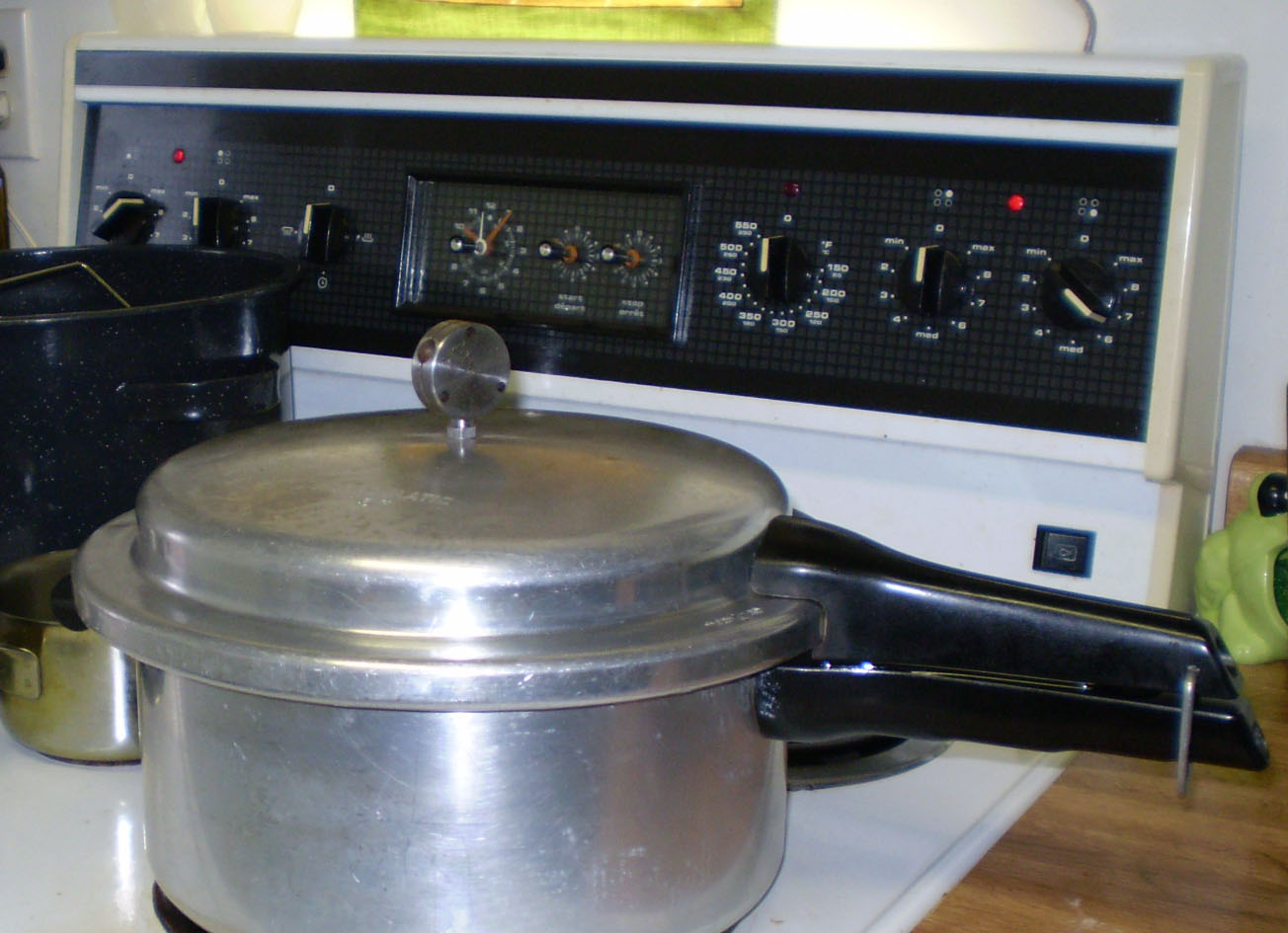
I decided to use my new (to me) canner to jar up some chicken breasts. It was a nice find that I got at the second hand joint, and after initial testing it worked well. However, today was the day to put it to the real test.
And the first test was of my temper, as the rack had completely disappeared. I have my suspicions as to who and why (hubby was eyeing up the rack and asking me if I really needed it, so I think it is now part of some "man" project). I had to improvise a rack from the bottom of a spring-pan that had lost its sides. We punched a bunch of more-or-less evenly spaced holes through it, hammered back the edges of the holes, and it seems to be working just fine. Strictly speaking, hubby did the hole punching. He feels that any job that involves smashing things with a hammer is his job. He's also ready to volunteer to blow things up too :)
This old canner (the manual was dated 1951) holds about 5 1-pint (500 mL) jars, unlike my new canner which will hold quart (litre) jars. I was able to put about 3 to 3-1/2 chicken breasts in each jar. I have to say that I was amazed at how much the chicken breasts squished down. It was also kind of disgusting, and I kept washing my hands because of the sheer gross factor. Eww!
So I'm enjoying the jiggle of the weight on the canner, and waiting for the timer to signal 75 minutes have passed. It's such a friendly sound, and takes me back to my childhood...

And the first test was of my temper, as the rack had completely disappeared. I have my suspicions as to who and why (hubby was eyeing up the rack and asking me if I really needed it, so I think it is now part of some "man" project). I had to improvise a rack from the bottom of a spring-pan that had lost its sides. We punched a bunch of more-or-less evenly spaced holes through it, hammered back the edges of the holes, and it seems to be working just fine. Strictly speaking, hubby did the hole punching. He feels that any job that involves smashing things with a hammer is his job. He's also ready to volunteer to blow things up too :)
This old canner (the manual was dated 1951) holds about 5 1-pint (500 mL) jars, unlike my new canner which will hold quart (litre) jars. I was able to put about 3 to 3-1/2 chicken breasts in each jar. I have to say that I was amazed at how much the chicken breasts squished down. It was also kind of disgusting, and I kept washing my hands because of the sheer gross factor. Eww!
So I'm enjoying the jiggle of the weight on the canner, and waiting for the timer to signal 75 minutes have passed. It's such a friendly sound, and takes me back to my childhood...
Friday, January 21, 2011
CannedFood UK
I found a terrific site today with recipes that focus on using canned food while still producing nutritious meals. They have a lot of recipes, a great many of which could be adapted for cooking with food storage. The site is CannedFood UK, and features recipes from chef James Martin. They also have a channel on YouTube in which some of the recipes are demonstrated. Check it out!
Monday, January 3, 2011
Food, Canning and Other Ruminations
Recently, I was at the second hand emporium and I came across a great find, a pressure canner with all the bits and pieces intact, including a new (still in the package) gasket and a replacement safety valve. Wow! I immediately bought it even though hubby complained that I already had one. If one is good, two is great.
Today, I tested it to make sure that the gasket made a good fit, and to determine what heat level I need to put the burner at once I have pressure up. I am pleased to report that it worked well, and being one of the weight style canners, I didn't have to worry about getting a gauge calibrated.
I have been reading up on canning things I've never tried canning before, such as bread, cake or butter. Yes, I know that the experts say don't do it. For example, at the University of Georgia, some experts did a study on canning cake. They took some bacteria that they knew isn't killed by high temperatures, deliberately introduced it to the cake batter, baked and sealed it, unsealed and tested it. The report does not actually state that the cake was subsequently processed in a pressure canner. Naturally, the heat-resistant bacteria survived the experience.
And yet, you can buy canned bread !
!
Similarly, the experts advise against canning butter because of botulism. For example, you can read the material from the National Center for Home Food Preservation, University of Georgia on this topic. However, they do not address the matter of those who recommend processing the canned butter in a pressure canner with the same directions one would use for any fatty meat/fish product. No actual research has been done on canning butter.
So, what it boils down to is that you have to decide whether or not you will take a chance with these canning practices, keeping in mind that some botulism cases have actually been caused by commercially canned goods. Back in the day, people were aware that there were dangers inherent in the canning process. Nevertheless, before the advent of electricity and freezers, it was the best method available for storing foods. So, people took their chances.
Before canning, a lot of the methods of storing foods over the winter involved caching food in a cellar, or a hole in the ground, or a cave, or an unheated building. A lot of this food suffered from the depredations of rodents, who not only nibbled on the foods, but left behind disease-ridden calling cards, and fleas (which also carried diseases). They frequently didn't have clean water to drink, and didn't know why they got sick.
We do know about these disease vectors, and so we can work to overcome them, but the bottom line is, life is not really safe.
My personal take? I think I'm going to try pressure canning butter like it was a nice fatty bit of meat, 75 minutes per pint, 90 minutes per quart at 10 lbs pressure. Update: After reading this post by Bonny of Opportunity Farm on Safe Survival Canning over at the Survivalist Blog.net, I'll only try canning stuff that I know is tested. Like most, I have an aversion to dying, or seeing someone I love die. After all, preparedness is all about 'better safe than sorry', isn't it.
Update: May 2011 - after doing more research, I'm looking into making and storing ghee. Once the milk solids have been removed from butter, clarified butter or ghee, can be stored for a significantly longer time. Check out this article here (a .doc file).
But I'malso still going to look at getting in some commercially canned butter or butter powder:
Or butter powder:
Today, I tested it to make sure that the gasket made a good fit, and to determine what heat level I need to put the burner at once I have pressure up. I am pleased to report that it worked well, and being one of the weight style canners, I didn't have to worry about getting a gauge calibrated.
I have been reading up on canning things I've never tried canning before, such as bread, cake or butter. Yes, I know that the experts say don't do it. For example, at the University of Georgia, some experts did a study on canning cake. They took some bacteria that they knew isn't killed by high temperatures, deliberately introduced it to the cake batter, baked and sealed it, unsealed and tested it. The report does not actually state that the cake was subsequently processed in a pressure canner. Naturally, the heat-resistant bacteria survived the experience.
And yet, you can buy canned bread
! Similarly, the experts advise against canning butter because of botulism. For example, you can read the material from the National Center for Home Food Preservation, University of Georgia on this topic. However, they do not address the matter of those who recommend processing the canned butter in a pressure canner with the same directions one would use for any fatty meat/fish product. No actual research has been done on canning butter.
So, what it boils down to is that you have to decide whether or not you will take a chance with these canning practices, keeping in mind that some botulism cases have actually been caused by commercially canned goods. Back in the day, people were aware that there were dangers inherent in the canning process. Nevertheless, before the advent of electricity and freezers, it was the best method available for storing foods. So, people took their chances.
Before canning, a lot of the methods of storing foods over the winter involved caching food in a cellar, or a hole in the ground, or a cave, or an unheated building. A lot of this food suffered from the depredations of rodents, who not only nibbled on the foods, but left behind disease-ridden calling cards, and fleas (which also carried diseases). They frequently didn't have clean water to drink, and didn't know why they got sick.
We do know about these disease vectors, and so we can work to overcome them, but the bottom line is, life is not really safe.
My personal take?
Update: May 2011 - after doing more research, I'm looking into making and storing ghee. Once the milk solids have been removed from butter, clarified butter or ghee, can be stored for a significantly longer time. Check out this article here (a .doc file).
But I'm
Or butter powder:
Tuesday, December 14, 2010
Non-Electric Lifestyle
I was reading Wendy's post over at Surviving the Suburbs about giving up her dishwasher to save electricity and become more eco-friendly, and it struck me that we all have our little guilty electric pleasures that will be hard to give up. I'm sitting here listening to my electric coffeemaker gurgling on the kitchen counter, and wondering how long I would need to pedal a bicycle generator to get my morning cup of joe.
There are so many things that we North Americans take for granted, and just never consider how difficult it would be if the lights went out for a very long time. Growing up, we didn't have an electric coffeemaker. Mom made it on top of the stove using a percolator; it went camping with us and made coffee just as happily on the camp stove as it did on the electric stove at home.
Many of my relatives had large kitchens with both electric and wood-burning cook stoves in them. One of my aunts had an oil-burning cook stove for use in the winter. One thing I remember vividly is watching my granny stick her hand into the over to gauge the heat and whether it was hot enough to stick a tray of cookies in. I wouldn't have a clue what felt hot enough. Mom's stove had a thermometer on the front of the oven door.
We've probably all seen those camping gadgets for making toast or popcorn, but these are not new inventions. There was a time when these are what people used. I remember sitting in front of the fire with a wire basket on a long handle full of popcorn kernels and watching them pop. I grew up with all those non-electric tools, although I will admit that when dad came home with that first electric coffee maker when I was in high school, that produced genuine excitement. With that baby in the house, my first major addiction was born. Mmmm, coffee!
Nevertheless, when I look at a lot of food storage sites, and prepper sites, even though we all talk (and write) about preparing for a time when there might not be electricity, we all have all kinds of electric gadgets for prepping with. Now that's ironic. M.D. Creekmore addressed the same issue in a recent post, 4 Unique Ways to Preserve Food. Honestly, I read a post from someone who is using an electric pressure cooker to can small batches!
This has driven me to an obsessive search for all those old-fashioned non-electric tools that my mother used to use. Amazon has an amazing selection of these products, and the prices are not bad at all:
There are so many things that we North Americans take for granted, and just never consider how difficult it would be if the lights went out for a very long time. Growing up, we didn't have an electric coffeemaker. Mom made it on top of the stove using a percolator; it went camping with us and made coffee just as happily on the camp stove as it did on the electric stove at home.
Many of my relatives had large kitchens with both electric and wood-burning cook stoves in them. One of my aunts had an oil-burning cook stove for use in the winter. One thing I remember vividly is watching my granny stick her hand into the over to gauge the heat and whether it was hot enough to stick a tray of cookies in. I wouldn't have a clue what felt hot enough. Mom's stove had a thermometer on the front of the oven door.
We've probably all seen those camping gadgets for making toast or popcorn, but these are not new inventions. There was a time when these are what people used. I remember sitting in front of the fire with a wire basket on a long handle full of popcorn kernels and watching them pop. I grew up with all those non-electric tools, although I will admit that when dad came home with that first electric coffee maker when I was in high school, that produced genuine excitement. With that baby in the house, my first major addiction was born. Mmmm, coffee!
Nevertheless, when I look at a lot of food storage sites, and prepper sites, even though we all talk (and write) about preparing for a time when there might not be electricity, we all have all kinds of electric gadgets for prepping with. Now that's ironic. M.D. Creekmore addressed the same issue in a recent post, 4 Unique Ways to Preserve Food. Honestly, I read a post from someone who is using an electric pressure cooker to can small batches!
This has driven me to an obsessive search for all those old-fashioned non-electric tools that my mother used to use. Amazon has an amazing selection of these products, and the prices are not bad at all:
Friday, December 10, 2010
Food Storage - Baking Necessities
Check out this post from the Jodie and Julie at Food Storage Made Easy. If you aren't familiar with their website, this is a good time to check it out. This is one of the best websites out their for those new to the food storage scene.
Baking powder is a real must for baking, and yet its storage life is quite short. Store the basic ingredients, baking soda and cream of tartar (both of which have very long storage lives) and you are set for years of baking to come.
Another great site is Safely Gathered In, which recently posted on this same topic.
Baking powder is a real must for baking, and yet its storage life is quite short. Store the basic ingredients, baking soda and cream of tartar (both of which have very long storage lives) and you are set for years of baking to come.
Another great site is Safely Gathered In, which recently posted on this same topic.
Friday, December 3, 2010
Canning
A few weeks ago, I was reading Kellene Bishop's Preparedness Pro blog and she had posted about reusable canning lids. A number of readers commented on the lids, and I recommend that you check out the blog, AND the comments. Initially, when I saw these re-usable lids, I was all enthused, and thought I would like to have some. This seems like it might be a useful item to have on hand.
However, I'm put in mind of a few recent blogs I read that asked if you are going broke prepping. It seems like there's always someone coming up with some new "must-have" preparedness product, and people flock to purchase them, which is fine if you have the money to spend.
However, for those of us on a budget, these new "must-haves" can be depressing to contemplate.
I reuse my metal ones. And I can pick them up at the dollar store very economically. For the price of one flat's worth of re-usable plastic lids and rubbers, I can pick up 10 or more packs of the tin lids. If you carefully inspect a used tin lid, you can readily tell when the sealing material is gone and not suitable for reuse. And even a new lid can fail to seal, which is why we test the seal after cooling.
So, while I think it would be wonderful to have the plastic re-usable lids, I believe that I will stock up on the tin lids.
However, I'm put in mind of a few recent blogs I read that asked if you are going broke prepping. It seems like there's always someone coming up with some new "must-have" preparedness product, and people flock to purchase them, which is fine if you have the money to spend.
However, for those of us on a budget, these new "must-haves" can be depressing to contemplate.
I reuse my metal ones. And I can pick them up at the dollar store very economically. For the price of one flat's worth of re-usable plastic lids and rubbers, I can pick up 10 or more packs of the tin lids. If you carefully inspect a used tin lid, you can readily tell when the sealing material is gone and not suitable for reuse. And even a new lid can fail to seal, which is why we test the seal after cooling.
So, while I think it would be wonderful to have the plastic re-usable lids, I believe that I will stock up on the tin lids.
Wednesday, December 1, 2010
A Couple of Interesting Blogs on Home Food Storage
Momzoo posted a blog about making tomato powder from her garden, complete with pictures. Thanks, Momzoo. It certainly was inspiring to see what one can accomplish with a dehydrator.
Another nice post on canning applesauce came from Michelle at my family prepared. It was also beautifully illustrated. I really like the hints and tips she provided.
Steve Dowdney, over at puttingup.com's blog has a nice post on making Christmas Pepper Jelly that sounds delicious.
I also found a really nice blog called Safely Gathered In on food storage which a section of recipes using food storage staples. The recipes are focused on the kind of food storage where you stock what you eat and eat what you stock, and most of the of the recipes have pictures.
Another great blog with food storage recipes is My Year Living on Food Storage. This blog regales the reader with one family's experiences with eating using food storage items, both the bulk staples and the store bought canned food pantry. It's very interesting as we learn with this family about what actually works out well and what doesn't. She also posts a list of books that have helped her find recipes to use the storage items.
The Everyday Gourmet Cooking with Long-term Food Storage
Emergency Food Storage & Survival Handbook: Everything You Need to Know to Keep Your Family Safe in a Crisis
It's in the Bag a New Approach to Food Storage
A Year's Supply In "Seven Days"
Independence Days: A Guide to Sustainable Food Storage & Preservation
Food Storage 101 Where do I begin? (Cookin' With Home Storage)
I Can't Believe It's Food Storage
Emergency Preparedness The Right Way
The Essential Food Storage Cookbook
Food Security for the Faint of Heart
Cooking with Food Storage Made Easy
SIMPLE RECIPES USING FOOD STORAGE
How to Develop a Low-Cost Family Food-Storage System
Not Your Mother's Food Storage
Preserving Food without Freezing or Canning: Traditional Techniques Using Salt, Oil, Sugar, Alcohol, Vinegar, Drying, Cold Storage, and Lactic Fermentation
Pantry Cooking, Quick &Easy Food Storage Recipes - 2006 publication
Root Cellaring: Natural Cold Storage of Fruits & Vegetables
Anyway, you get the picture. There are lots of cookbooks and guides to help you make choices that will fit your budget, and that your family will eat.
Another nice post on canning applesauce came from Michelle at my family prepared. It was also beautifully illustrated. I really like the hints and tips she provided.
Steve Dowdney, over at puttingup.com's blog has a nice post on making Christmas Pepper Jelly that sounds delicious.
I also found a really nice blog called Safely Gathered In on food storage which a section of recipes using food storage staples. The recipes are focused on the kind of food storage where you stock what you eat and eat what you stock, and most of the of the recipes have pictures.
Another great blog with food storage recipes is My Year Living on Food Storage. This blog regales the reader with one family's experiences with eating using food storage items, both the bulk staples and the store bought canned food pantry. It's very interesting as we learn with this family about what actually works out well and what doesn't. She also posts a list of books that have helped her find recipes to use the storage items.
The Everyday Gourmet Cooking with Long-term Food Storage
Emergency Food Storage & Survival Handbook: Everything You Need to Know to Keep Your Family Safe in a Crisis
It's in the Bag a New Approach to Food Storage
A Year's Supply In "Seven Days"
Independence Days: A Guide to Sustainable Food Storage & Preservation
Food Storage 101 Where do I begin? (Cookin' With Home Storage)
I Can't Believe It's Food Storage
Emergency Preparedness The Right Way
The Essential Food Storage Cookbook
Food Security for the Faint of Heart
Cooking with Food Storage Made Easy
SIMPLE RECIPES USING FOOD STORAGE
How to Develop a Low-Cost Family Food-Storage System
Not Your Mother's Food Storage
Preserving Food without Freezing or Canning: Traditional Techniques Using Salt, Oil, Sugar, Alcohol, Vinegar, Drying, Cold Storage, and Lactic Fermentation
Pantry Cooking, Quick &Easy Food Storage Recipes - 2006 publication
Root Cellaring: Natural Cold Storage of Fruits & Vegetables
Anyway, you get the picture. There are lots of cookbooks and guides to help you make choices that will fit your budget, and that your family will eat.
Saturday, November 13, 2010
What's First?
Generally speaking, all survivalists talk about stockpiling food, and goods, and acquiring skills. However, I'm of the opinion that you need to start with a plan. I've looked at a lot of sites that give lists, and some even suggest the order to buy things in.
In my ramblings on the internet, I have come across a few sites that I think offer some valuable information that can help you plan.
Food Storage Made Easy is a good site when you are trying to figure out how to get started with food storage. They have a newsletter you can sign up for with "baby steps" to getting your food storage going on, or get the whole thing as an e-book.
Secrets of Urban Survival is another great site from David Morris. He sells a course which helps you to decide what you need to prepare for and then how to plan your preparations. It has gotten very good reviews, and I'm saving up to buy it for myself. Sign up for his newsletter. You can also check out his new book, Urban Survival Guide: Learn The Secrets Of Urban Survival To Keep You Alive After Man-Made Disasters, Natural Disasters, and Breakdowns In Civil Order.
The book One Second After has generated a certain amount of interest in preparedness due to its realistic portrayal of what could/would happen after an EMP event. The progression of societal breakdown would be fairly similar after any large-scale sudden breakdown of the commercial system which moves food and goods around North America. I read it with great interest and recommend it as both a good read, and food for thought.
In my ramblings on the internet, I have come across a few sites that I think offer some valuable information that can help you plan.
Food Storage Made Easy is a good site when you are trying to figure out how to get started with food storage. They have a newsletter you can sign up for with "baby steps" to getting your food storage going on, or get the whole thing as an e-book.
Secrets of Urban Survival is another great site from David Morris. He sells a course which helps you to decide what you need to prepare for and then how to plan your preparations. It has gotten very good reviews, and I'm saving up to buy it for myself. Sign up for his newsletter. You can also check out his new book, Urban Survival Guide: Learn The Secrets Of Urban Survival To Keep You Alive After Man-Made Disasters, Natural Disasters, and Breakdowns In Civil Order.
The book One Second After
has generated a certain amount of interest in preparedness due to its realistic portrayal of what could/would happen after an EMP event. The progression of societal breakdown would be fairly similar after any large-scale sudden breakdown of the commercial system which moves food and goods around North America. I read it with great interest and recommend it as both a good read, and food for thought.
Subscribe to:
Posts (Atom)